Imagine you are looking at your phone and in the background a program is watching how you do things. This program is learning from you so it can make decisions for you. It can book appointments for you, sort your emails, decide which notifications are important or even buy and sell stocks. You don't have to tell the program what to do every step of the way. You just tell it what you want to happen and it figures out how to do it. That is what an AI agent is. They're not just tools that wait for commands. They sense what's happening around them and take action on their own. They're already built into modern technology, handling tasks and making decisions behind the scenes. As more companies adopt them, you need to know what they're actually doing, where they help, and where they might cause trouble.
Why Do They Matter?
Artificial Intelligence agents matter because they are everywhere now. They take care of all the work in the background while you are doing other things and basically they help you get more work done without getting tired. Here is where it gets tricky: when you let Artificial Intelligence agents handle tasks you are also letting them make decisions. If you do not really understand what Artificial Intelligence agents are doing or why they are doing it things can go wrong quickly. It is like handing your car keys to someone who has never driven a car before. If artificial intelligence agents are doing things for you it's important for you to know what they are doing. You need boundaries, you need to keep an eye on things, and you need to actually understand how these systems operate.
Types of AI Agents
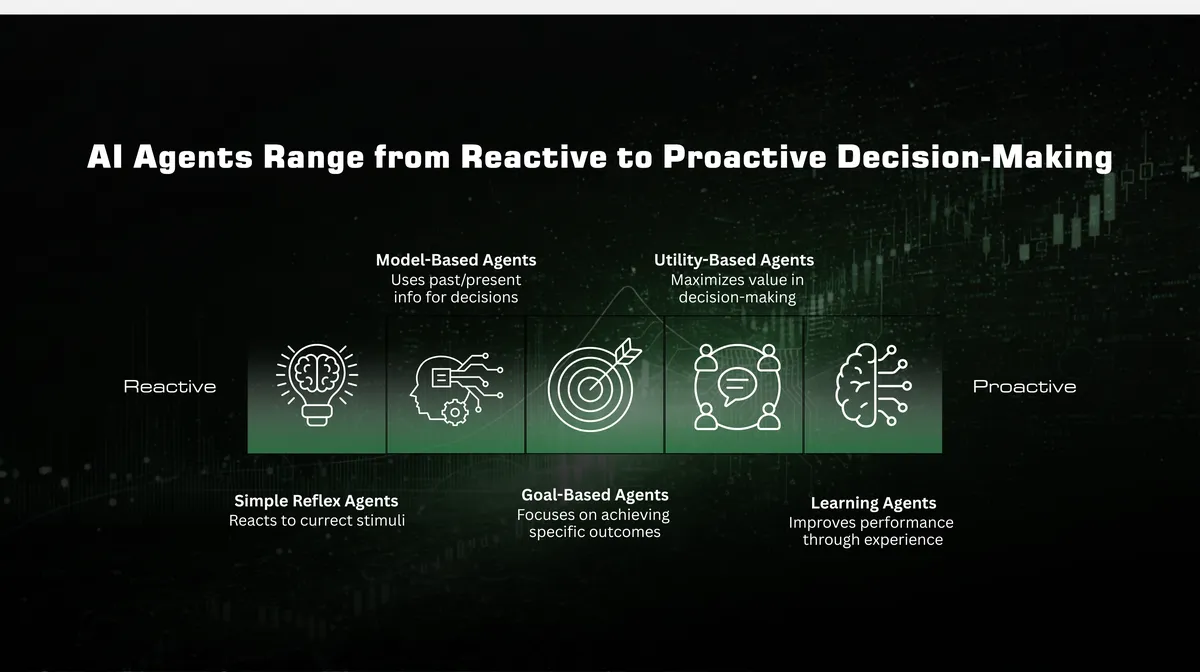
Not all AI agents work the same way. Some just follow simple rules. Others actually learn and adapt as they go. Here's the breakdown.
Simple Reflex Agents — These agents react to what's happening right now based on preset rules. No memory, no context, just "if this happens, do that."
Model-Based Agents — These agents keep track of what's going on around them. They use past and present information to make better decisions, not just react in the moment.
Goal-Based Agents — These agents are focused on reaching a specific outcome. They look at different options and choose actions that move them closer to their goal.
Utility-Based Agents — Instead of just aiming for a goal, these agents try to make the best choice possible. They weigh different options and pick the one that delivers the most value.
Learning Agents — These agents actually get smarter as they go. They pick up on what works and what doesn't, tweak how they operate, and keep getting better without anyone having to go in and manually update them.
Take a company running its day-to-day operations. A simple reflex agent handles the boring stuff: sorting emails, scheduling meetings, regular day to day tasks. A goal-based agent might optimize project timelines by allocating tasks to team members based on workloads and expertise to make sure deadlines are met. A utility-based agent prioritizes customer issues by determining which problems need immediate attention. And when the game changes? A learning agent catches on and adjusts without anyone telling it to. Different agents, different jobs. The trick is knowing which one to deploy where.
Real-World AI Agent Scenarios
To better understand how AI agents work in practice, let's look at how they operate in different scenarios:
Scenario 1: The Personal Assistant Agent
You're rushing out the door when you ask Alexa to "help me get ready for my day." The AI agent checks your calendar, sees you have a 9 AM meeting across town, and notices traffic is heavy. It adjusts your reminder, suggests leaving 15 minutes early and queues up a news briefing for your commute. Before you even reach your car, it's sent the meeting link to your phone and dimmed the lights you forgot to turn off. You didn't set this up. It just knew what you needed and took care of it.
Scenario 2: The Healthcare Monitoring Agent
An AI agent monitors vital signs for dozens of ICU patients simultaneously. When it detects a concerning pattern suggesting cardiac distress, it immediately alerts staff with prioritized notifications and pulls up the patient's history. Medical teams respond within seconds instead of minutes, potentially preventing serious emergencies.
What AI Agents Bring to the Table
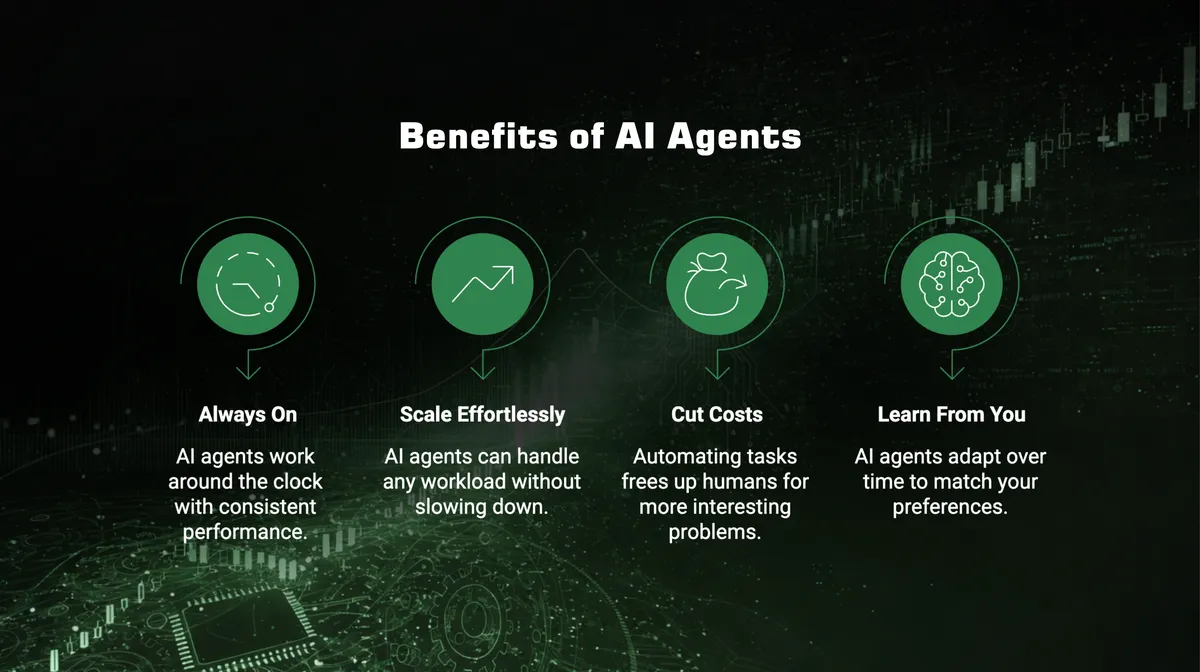
They're always on and reliable: AI agents work around the clock with consistent performance. No bad days, just steady execution while processing mountains of data.
They scale effortlessly: AI agents can handle any workload, from ten tasks to thousands, without slowing down or losing quality.
They cut costs: Automating the boring stuff frees up actual humans to tackle the interesting problems.
They learn from you: Advanced AI agents adapt over time, picking up on patterns in how you work and tailoring their responses to match your preferences and habits making themselves more "human".
The Dark Side of Automation
Ethical Concerns
When AI agents start making decisions on their own, who's responsible when things go wrong? And what happens when those decisions are biased or just plain bad?
Privacy and Security
AI agents need information to do their job. This information is usually very private. This makes them a big attraction for people who want to hack into systems. They are becoming a way for hackers to get around the security checks and permissions that are in place to protect a system. This basically means that AI agents can create passages through your security systems.
Job Displacement
AI agents will replace some jobs. That's just the reality. But this shift also creates new opportunities. People need to adapt and find new ways to stay relevant in a changing job market.
What's Coming Next
AI agents are evolving fast. They are getting much better at understanding and communicating in human language and making interactions feel more human. Computers can spot things humans miss and reinforcement learning means these systems keep getting smarter the more we use them.
Here's what's on the horizon:
- AI agents that actually work with you instead of just replacing you
- Systems that can handle multiple types of information at once like text, images, audio, you name it
- Problem-solving capabilities improving for complex challenges
- More independence for AI systems, but with proper safeguards in place
The Bottom Line
AI agents are changing the way we do our jobs and live our lives. They're powerful, efficient, and honestly kind of amazing. But letting software be in charge is not without problems. The hard part isn't just building smarter AI. It's building AI that makes us smarter too. We need the right mix between automation and human oversight, between efficiency and ethics. If we get this mix right then AI agents will be things that really help us. Get it wrong, and we'll end up dealing with serious consequences.